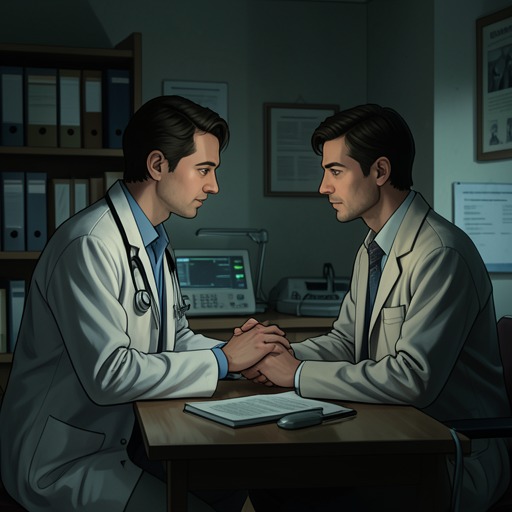
James O’Bryant
Five Days at MemorialJames O’Bryant’s story follows a prolonged struggle with advanced facial cancer and a close relationship with his surgeon, Anna Pou. His repeated operations, the crisis that brought Pou back to the operating room after her arrest, and his later choice of hospice show the persistence of their bond amid illness and public controversy. The account presents him not merely as a patient caught in Pou’s legal story, but as a father and husband whose decisions and family life remain at the center of his own care.
Identity and Illness
O’Bryant was fifty-three, a working father of two who lived with his family in a house on a bayou off the Pearl River. Before seeing a doctor, he had put off addressing pain in his mouth because he thought it came from bad teeth. He was not a smoker or drinker, unlike many of Pou’s other patients with disfiguring facial cancers. By the time she met him in January, his condition had already become a source of serious concern to her.
Brenda O’Bryant later connected his illness to a chemical accident in Bogalusa in 1995, which had poisoned thousands and led to a class-action lawsuit settled months before Hurricane Katrina. She recalled an orange cloud over the city for several days and believed it had caused her husband’s cancer. The account records her belief, not a confirmed medical finding about the cause of his disease.
Treatment and a Close Care Relationship
Pou’s first major operation on O’Bryant lasted more than twenty hours. Before it began, she explained to him and his family how she planned to remove a large tumor from the sinus above his teeth and reconstruct his face. She embraced and kissed family members, including the children, and joined them in prayer. Her tenderness affected O’Bryant’s brother-in-law, who cried at the way she treated the family; he had a history of health problems and had not experienced that kind of attention from a doctor.
During months of radiation treatment, O’Bryant and Brenda sometimes waited three or four hours for appointments. Once Pou saw him, Brenda recalled, she examined him thoroughly and let the couple stay to ask whatever questions they had. Pou also gave them her cell-phone number and encouraged them to call at any hour about anything. They used it often, extending the relationship beyond scheduled visits and procedures.
The month before Katrina, radiation had damaged skin beneath O’Bryant’s right eye. Pou moved a flap of skin from his forehead to fill the affected area, leaving it attached by a narrow stalk until it could take root. A further operation was planned to divide that connection. As the hurricane approached, however, Pou postponed the procedure rather than admit him to the hospital during the storm.
Recurrence and the Interrupted Operation
After Katrina, Pou told Brenda that she could not continue practicing and needed time away because of questions about what had happened during the hurricane. The decision was painful for her to convey: O’Bryant was due to undergo another operation with her, the third she would have performed on him. Although she could no longer be his surgeon, she continued to offer support and invited the couple to call her.
O’Bryant’s facial pain later returned. Imaging showed that cancer had grown behind his left eye and needed to be removed. He was uncertain about undergoing another extensive operation. Pou’s department chairman, Dan Nuss, believed he could remove the tumor, and O’Bryant agreed to proceed with Nuss as surgeon and Pou assisting with facial reconstruction.
The operation on July 6 lasted many hours. The surgeons removed tissue in stages, checking samples for cancer as they worked deeper. They discovered that the tumor had invaded bone around a blood vessel removed in an earlier procedure, a development the scan had not shown. Removing all of it would have required opening O’Bryant’s skull, an operation they believed he could not withstand. They closed his face as well as they could and left part of the tumor in place. The procedure therefore addressed the disease while confronting a limit: complete removal would have demanded more than they judged his body could survive.
An Emergency and Pou’s Return to Surgery
On July 16, Brenda called Pou after a hospital trainee, mistaking a scab for a stitch, had pulled part of it away. O’Bryant had seemed all right when he was discharged, and the couple made the two-hour drive home to Bogalusa. Later, Brenda noticed bleeding and contacted Pou, who advised her to apply something cold and take him to the nearest emergency room. Pou also tried to speak with the emergency physician, initially having difficulty getting the call through.
A stitch appeared to stop the bleeding, but Pou was concerned that blood could be collecting beneath the surface. When O’Bryant’s pain worsened, the emergency physician did not appear convinced by his report. His condition then deteriorated suddenly, and he was transferred by ambulance. He lost so much blood that the team gave him two units during the trip to Baton Rouge.
Pou prepared an operating room and called Nuss in on Sunday night. Nurses arrived, and the surgical team operated through the night. By Monday morning, Pou and Nuss had closed the facial defect, and they gave O’Bryant additional blood to replace what he had lost. Pou tried to reassure Brenda that the bleeding might have occurred regardless of the emergency physician’s actions and that, without stopping at the local emergency room, the crisis might have unfolded in their car on the way to Baton Rouge. After O’Bryant was settled in intensive care, Pou left for another hospital and another scheduled operation, having not slept.
Nearly six months after Pou’s arrest, she had not returned to surgery and was working in teaching and administration in Baton Rouge. When O’Bryant faced another major operation, she worried she might not reach the hospital before he went in. She arrived as he was being wheeled toward the operating room; he recognized her, sat up, and welcomed her. Pou stayed with Brenda and the family while he underwent surgery, and they were relieved when he came through it.
The O’Bryants knew Pou had not told them what had happened at Memorial. She explained that her lawyer would not let her discuss it, but told them she had loved her patients and would never knowingly hurt one. They believed her. Brenda regarded Pou as a Christian guided by her faith and rejected the allegations against her. The book also shows the cost of the case to the family: Brenda and James had lost access to the doctor they trusted during a period of grave need.
Hospice and the Limits of Treatment
Later, scans showed that the cancer had advanced through the bones of O’Bryant’s face and reached his brain. He was still only fifty-three. Nuss had recently performed another extensive operation and, when discussing the new findings, told O’Bryant that chemotherapy would likely make him sick. The alternatives were to try chemotherapy or stop anti-cancer treatment and enter hospice, where care would focus on controlling symptoms and keeping him comfortable. O’Bryant chose hospice.
Pou remained in contact with Brenda, calling repeatedly and offering to be available morning or night, any day of the week. As the O’Bryants’ thirty-second wedding anniversary approached, Brenda described James as eating little, becoming so weak he could barely walk, and having trouble sleeping. The hospice nurse estimated that he had days left. Pou had struggled to make time to visit because of work and a rally, but she asked for directions and made a long detour to the family’s small red house on the bayou.
When Brenda announced Pou’s arrival, Pou climbed onto O’Bryant’s bed and embraced him. He opened his right eye; his illness and earlier reconstruction had profoundly changed his face. Pou asked whether she could see a smile. His speech was difficult for her to understand, and Brenda interpreted his expression as a smile and conveyed his concern for how Pou was doing. The scene returns the account to the relationship’s most durable element: even as treatment options narrowed, O’Bryant and his family remained connected to the physician who had cared for him over years of operations and recovery. The narrative records his decision for hospice and Pou’s visit, but does not establish what happened to him afterward.